

A hands-on decision-training simulator for AML teams at crypto companies

Practise difficult AML decisions before you face real client cases

Investigation simulations, structured feedback and measurable competency assessment.

Fewer mistakes during onboarding
Up-to-date AML/CFT scenarios
Documented training outcomes
Cases built on FATF materials and applicable AML/CFT requirements Structured results for internal control and audit
The problem

Theory alone doesn't build a lasting skill

Policies and automated tools set the rules. But the analyst still has to interpret the alert, weigh limited or contradictory information, choose the right checks and document the reasoning behind the decision.

Junior analyst mistakes

Even with screening configured correctly, the quality of a decision depends on the analyst's professional judgement. AML Casework lets analysts practise decisions on training scenarios, receive structured feedback and repeat difficult typologies with no risk to clients or the business. The senior analyst steps in for a targeted review of identified gaps instead of checking every step by hand.
Changing requirements

Regulatory requirements, supervisory expectations and financial-crime methods keep changing. The case library is updated to reflect new legislation, guidance and typology material. Every module lists its version, update date and the sources used.

Documented training

The platform records assigned modules, completion dates, the analyst's decisions, assessment results, repeat attempts and the version of the training material. This data forms a structured report for internal control, audit and, where required, supervisory review.

The product

How the simulator works

The analyst works through the same kind of cases they will meet in real work.

Investigate

Study the client profile, documents, the reason the alert fired and the flow-of-funds graph.

Decide

Close the alert, request additional information or EDD, escalate to the MLRO or draft an STR/SAR.

Debrief

Get feedback on missed risk indicators, the quality of the rationale, the action chosen and the use of investigation resources.

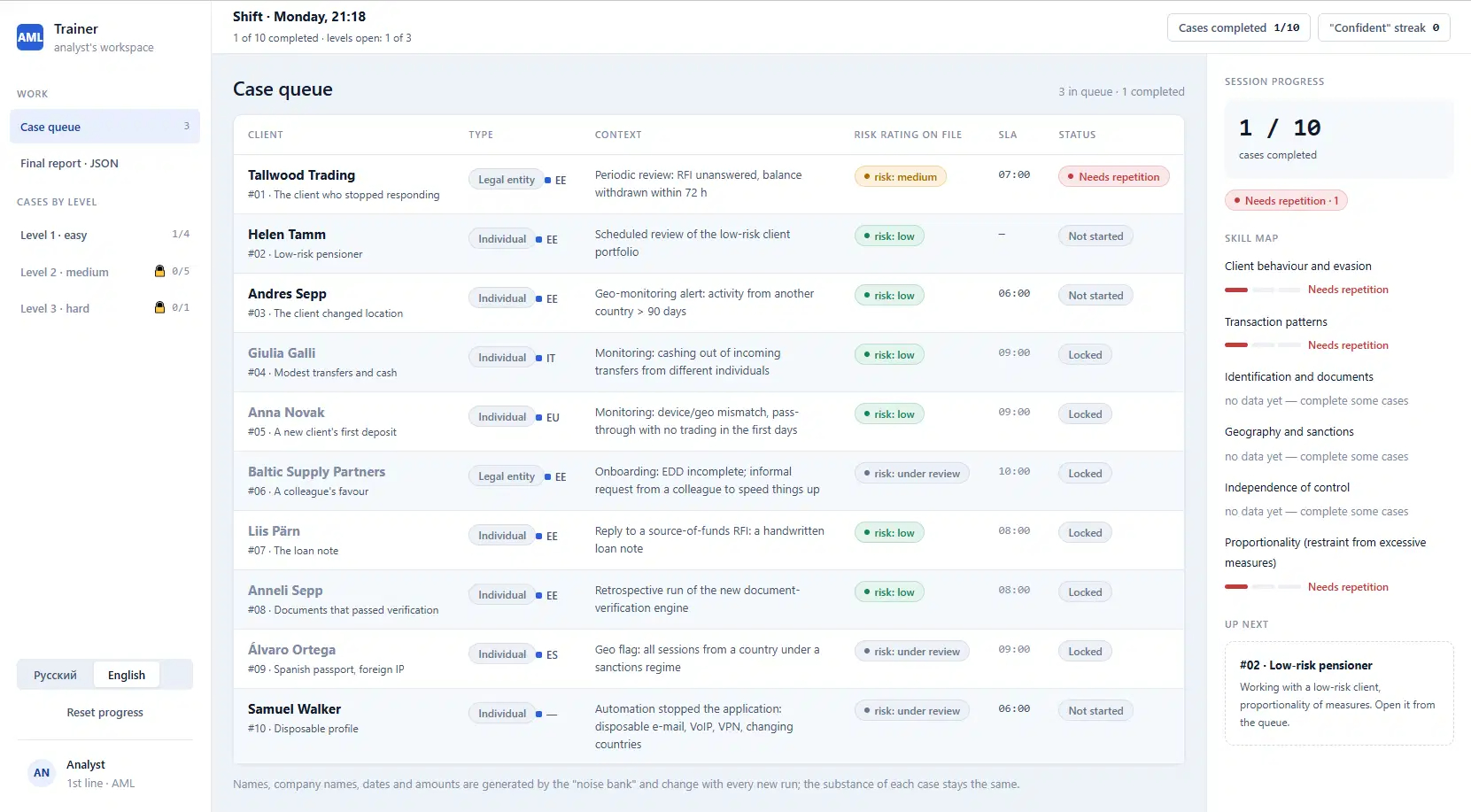
AML Casework — case queue
The case queue — levels, SLA timers, and a skill map that marks what needs repetition.
Inside a case

Investigation resources are limited — and every decision must be justified and assessed

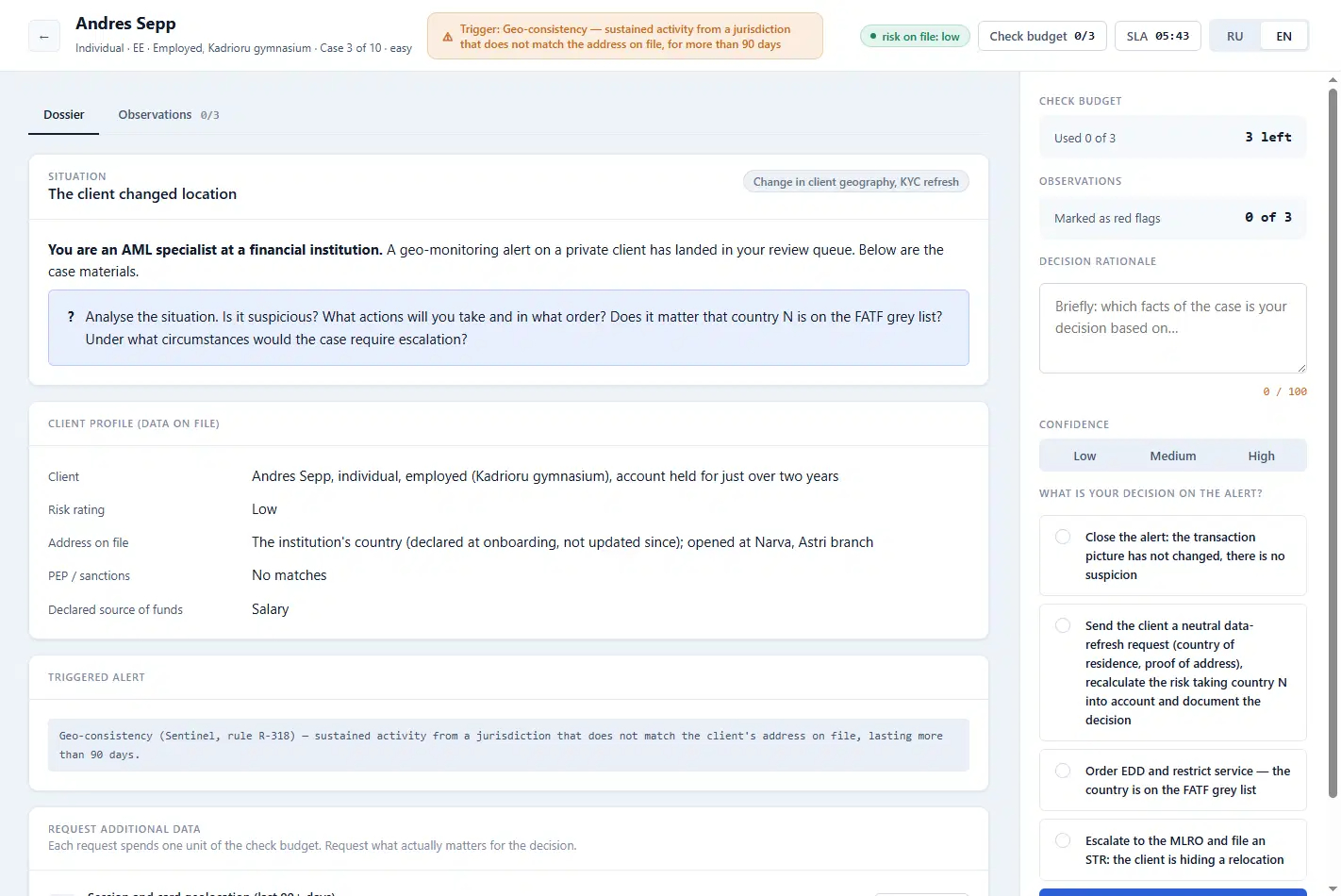
AML Casework — case detail
One case: dossier, triggered alert, check budget, written rationale and a confidence rating.
Check budget

A limited number of requests

In a training scenario the number of additional requests is limited. This teaches the analyst to ask for information that genuinely affects the risk assessment. The limit is a simulator mechanic and does not replace the mandatory checks required by law and the company's internal procedures.

Rationale

A decision without a written rationale doesn't count

The analyst must state the facts, risk indicators and internal-procedure provisions the conclusion rests on.

Confidence

Confidence calibration

The analyst states how confident they are in the decision. The platform compares it with the outcome and flags overconfidence and topics that need repetition.

Why it works

Repeat until it becomes reflex.

Classic training
Read → test → forget
Pass once, at 60%
Certificate of attendance
Simulation
Do → fail → debrief → repeat
Master at 90% — and make it stick
A record of every decision, timing and personalised analytics
Short lecture → simulation → spaced repetition → re-run → exam → certificate
For the business

Results for the business

Standardised onboarding

A single training programme and clear criteria for clearing analysts to work independently.

Measurable decision quality

Accuracy of conclusions, missed risk indicators, justified requests, escalation quality and adherence to target handling time.

A structured training log

History of assignments, completions, decisions, scores, repeat attempts and material versions — per employee and per team.

Custom modules

Your working cases — in the training programme

By separate agreement, we convert your company's anonymised cases into training modules that reflect its products, internal procedures and the risk scenarios analysts actually encounter.

The procedure for transferring, anonymising, storing and deleting materials is set out in the contract and data-processing terms.

Not another course. Practice between theory and real work

Senior analyst mentoring

Passes on practical experience and the company's internal context. But it takes a lot of senior time and is hard to scale across the whole team.

Training from the screening vendor

Helps master the functions and logic of a specific tool. It usually doesn't account for your company's internal procedures, risk appetite or product scenarios.

Certification course

Provides a structured theoretical foundation and confirms programme completion. But a single exam doesn't always show how an analyst makes and justifies decisions in difficult situations.

Corporate LMS

Centralises training assignment, completion tracking and reporting. The result depends on the content: standard modules tend to test knowledge rather than the quality of practical decisions.

AML Casework

Your cases. Every decision recorded. Analytics on the team's competency gaps and documented training outcomes for internal control, audit and supervisory review.

AML Casework doesn't replace internal policies, mentoring or an LMS. It brings them together into a repeatable process of practical training and decision assessment.

Pricing

Transparent annual pricing.

By number of analysts
1–5 analysts
€500/ analyst / year
Buy a subscription
6–10 analysts−10%
€450/ analyst / year
Buy a subscription
11 and more
On request
Request a price
What's included
The full case programme: FATF typologies and MiCA
Continuous case updates as regulation and typologies change
Adaptation to your internal policies and procedures
Exam and named certificate
A record of every decision and a report for the regulator
Analytics per analyst and per team